Welcome to the Salomon Laboratory
Decoding how molecular networks shape immune-cell responses.
Immune cells must decide when to respond, how strongly to act, and when to stop. The Salomon Laboratory studies the molecular messages that guide those choices, both in natural immune responses and in engineered cell therapies. By combining advanced mass spectrometry, biochemistry, and computational analysis, we can measure thousands of signaling changes at once and discover how they work together to shape what cells ultimately do.
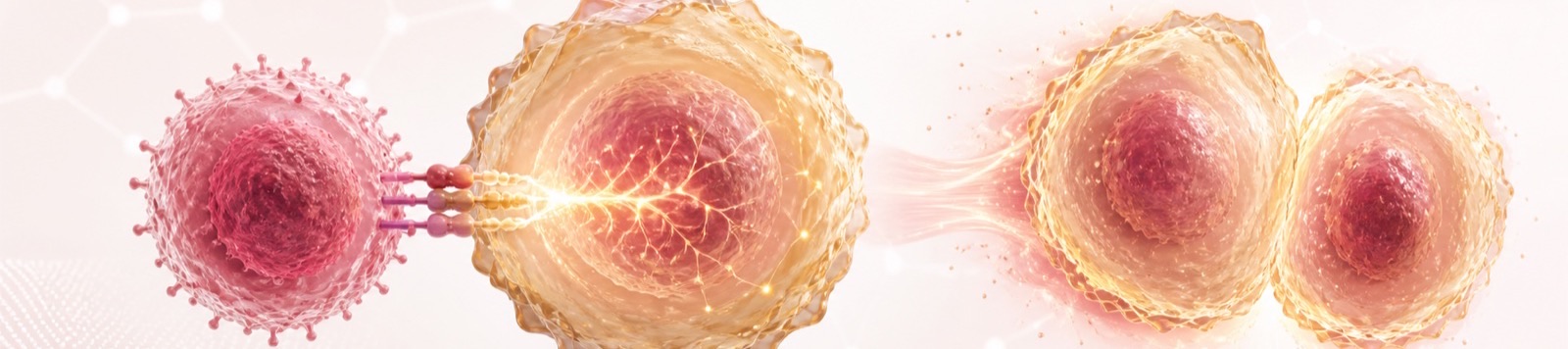
One current focus asks how a target cell interprets contact with an engineered immune cell. Because receptors used for recognition can themselves signal, the target may grow, survive, or be eliminated. Cell-of-origin phosphoproteomics lets us resolve both sides of the interaction and connect molecular mechanisms with biological outcomes.
-
What controls immune-cell decisions?
We define how receptors, kinases, phosphatases, feedback, and pathway crosstalk organize signaling responses.
-
How do interacting cells respond?
We resolve molecular responses from each cell type in mixed cocultures, exposing changes hidden in the combined sample.
-
Which mechanisms shape outcomes?
We connect quantitative phosphorylation networks with biochemical mechanisms and cellular outcomes.
Latest published discovery Science Signaling
CAR target cells are active participants
Most CAR studies ask what the engineered T cell does. Our recent study asks what happens inside the contacted target cell. Cell-of-origin phosphotyrosine proteomics shows that a CSF1R-directed CAR triggers CSF1R-like signaling in THP-1 target cells, whereas CD19-CAR contact does not produce the same signaling response in Raji targets.
- The target signals: CSF1R Tyr723 and downstream ERK phosphorylation increase after CSF1R-CAR contact.
- The mechanism is target-cell intrinsic: the response requires CSF1R kinase activity but not T-cell Lck activity or actin polymerization.
- Cell ratio changes the outcome: target-rich conditions promote THP-1 growth, whereas effector-rich conditions produce target-cell lysis.
Read the Science Signaling paper (opens in a new tab)
View in PubMed (opens in a new tab)

Text description of CAR target-cell diagram
Overall structure: The diagram reads from left to right as the number of CSF1R-CAR T cells per target cell increases. Rose circles represent CAR T cells, gold circles represent CSF1R-positive target cells, and an arrow along the bottom shows the increasing effector-to-target ratio.
- Target-rich contact, low effector-to-target ratio
- A CAR T cell contacts a target cell and activates CSF1R phosphotyrosine signaling. Under these target-rich conditions, the observed outcome is target-cell growth.
- The target is not passive
- Cell-of-origin phosphoproteomics separates signals from the two cell types. Target-cell signaling requires the kinase activity of CSF1R. T-cell Lck activity and actin polymerization are not required for this response.
- Effector-rich contact, high effector-to-target ratio
- Multiple CAR T cells contact a target cell. Under these effector-rich conditions, the observed outcome shifts to target-cell lysis.
CSF1R Low Ratio
A musical take on the target-cell response.
Music created with Suno.com.
